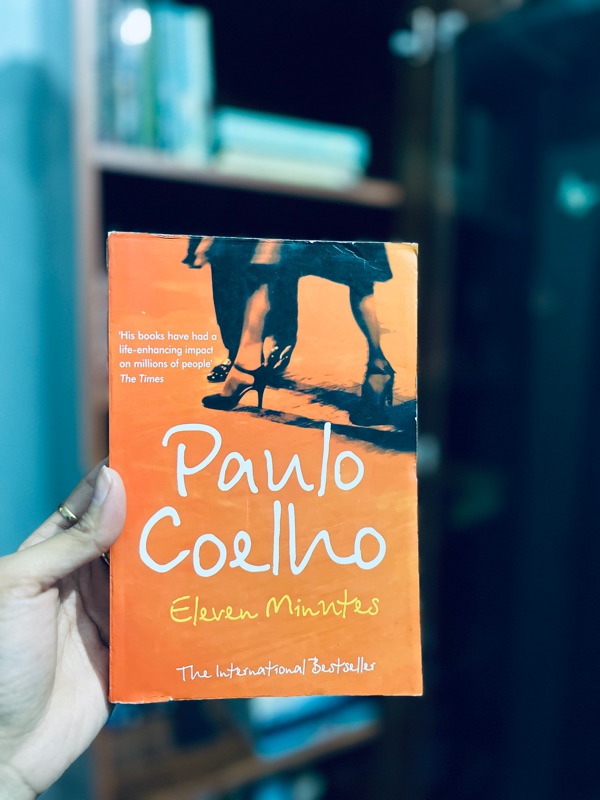
Eleven Minutes - By Paulo Coelho

"No one loses anyone, because no one owns anyone. That is the true experience of freedom: having the most important thing in the world without owning it."

Paulo Coelho’s this piece has always been one of my favourites in every way. It’s a thought provoking novel about love, desire and self discovery.

Eleven Minutes is a deeply moving story about Maria, a young woman from a small town in Brazil who dares to dream beyond the life she knows. With hopes of adventure and a brighter future, she sets out on a journey that takes her to Geneva, where she believes success awaits. But reality is crueler than she imagined, and when her dreams slip through her fingers, she finds herself drawn into the world of prostitution—not out of choice, but out of necessity.

To protect herself from pain, Maria detaches from her emotions, convincing herself that love is nothing more than an illusion and that intimacy is merely a transaction. Yet, even in the darkness, she refuses to let go of her dreams. She saves money, clinging to the hope of returning home to start fresh. Then, she meets Ralf, a Swiss painter who sees something in her that no one else does—her soul. Through his gentle presence, Maria begins to question everything she once believed about love, passion, and self-worth. Their connection forces her to face the scars of her past and rediscover the fragile, beautiful possibility of love.

The title, Eleven Minutes, refers to the brief moments of physical pleasure that fade in comparison to the depth of emotional and spiritual fulfillment. It is a reminder that true connection goes beyond the physical—it is about understanding, vulnerability, and the courage to love despite pain.

Paulo Coelho’s writing is raw, poetic, and deeply introspective. Maria’s journey is not just about survival; it is about finding meaning in a world that often mistakes pleasure for happiness. The novel challenges the way society defines love and desire, urging readers to look beyond the surface and seek something deeper.

Some moments in the book may feel repetitive, and Maria’s transformation might not resonate with everyone. But for those who have ever felt lost, broken, or afraid to love again, Eleven Minutes offers a story that is both heartbreaking and hopeful. It is a reminder that even in life’s darkest moments, there is always a chance for redemption, for love, and for a new beginning.

And here we end with our ritual;

"When you find your path, you must not be afraid. You need to have sufficient courage to make mistakes."

AS: Happy Reading! 😃

Comments

Popular posts from this blog

Madhushala - By Harivansh Rai Bachchan

“Mitti ka tan, masti ka man, kshan-bhar jeevan — mera parichay.” I think most of us have heard of Madhushala since childhood — though many may not have actually read it. I remember watching Amitabh Bachchan recite its verses on award shows, reality shows, and even on KBC. A few years ago, I finally decided to pick up a copy for myself, and to my surprise, I realised it might be the longest poem I’ve ever read — or will ever read. A true gem of Indian literature, Madhushala has 135 verses, each one as thoughtful as the next. Recently, while looking for another book on my shelf, I came across it again, read through a few pages, and felt like sharing it here. Madhushala is one of the most celebrated works in Hindi poetry, written by the legendary Harivansh Rai Bachchan. While it speaks of wine, taverns, and cups, it is not about drinking in the literal sense. These are thoughtful metaphors used to reflect on life, emotions, struggles, and dreams. For Indian readers, Madhushala holds a spe...

The Rudest Book Ever - By Shwetabh Gangwar

He argues: Many people have kids not because they are ready, but because society tells them “that’s what you do,” or because they believe a baby will suddenly make life happy and perfect. He’s clear—bringing a child into the world just to fix your own problems or to fit in is unfair to the child. His main message is simple: a child isn’t your happiness button, it’s a huge responsibility that deserves serious thought. Shwetabh uses this example to show how people often make life’s biggest choices without really thinking. I am not a fan of any self-help books, but this one surprised me with its style, and I came to know later that the genre is self help book; otherwise I might not have picked up! The book feels like a wake-up call. Author’s blunt, direct way of writing grabs your attention. He talks on topics like rejection, self-worth, avoiding society’s traps, and the difference between chasing short-term happiness and building real, lasting contentment. Reading it feels like sitting w...

Awakening the Divine Feminine (The Pancha Prakriti Goddesses) – By Adi Krsna Rama

Lately, I have been listening to a lot of spiritual podcasts on YouTube, and spirituality as a topic has always fascinated me, since childhood. Everyone defines it differently and seeks something unique through it. Maybe this ongoing curiosity led me to this book. Interestingly, this is the only book I have ever bought without any recommendation; no reviews, no prior knowledge, nothing. I just came across it while browsing books on Amazon and instantly felt attracted to it. Sometimes, energies guide you toward certain things, they speak to you, help you make choices—and this book was one of those moments. I am really glad I trusted that instinct. The book explores the divine feminine through goddesses and their energies—how each goddess resides within us, how we can awaken their energies, and how our personalities often resonate their traits. It beautifully reminds us that spirituality is everywhere—in everything we do and everything around us. All it takes is awareness and a willingne...