“There is your truth and there is my truth. As for the universal truth, it does not exist.”
I read this triology by Amish Tripathi in 2020, but its impact stayed with me, inspiring me to write this review today after 5 years!
It tells the story of Lord Shiva, but in a very different way. Instead of showing him as a god from the start, the author presents him as a simple man – a tribal leader from Tibet – who becomes a legend because of his actions, choices, and beliefs.
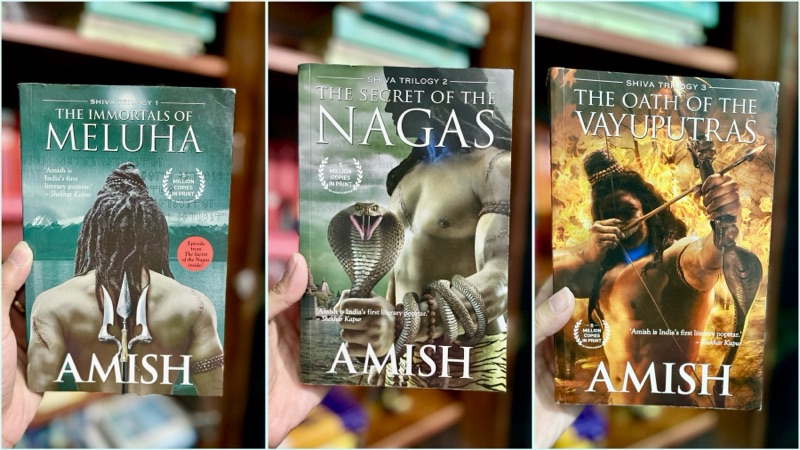
(Includes The Immortals of Meluha, The Secret of the Nagas, and The Oath of the Vayuputras)
The first book, The Immortals of Meluha, introduces us to the land of Meluha, a perfect kingdom that believes Shiva is the ‘Neelkanth’, their saviour. The story is fast-paced and filled with interesting characters and ancient Indian philosophies.
“Har har Mahadev – Every man is a Mahadev.”(A powerful line showing that divinity lies in all of us.)
In the second book, The Secret of the Nagas, Shiva goes on a journey to find out the truth behind his enemies. He learns that the world is not just black or white – it’s full of grey areas. This book brings more twists, mysteries, and emotional depth.
“A leader does not define what is right. He defines what is right for his people.”
The third book, The Oath of the Vayuputras, is where Shiva’s mission reaches its final stage. There is war, sacrifice, and a lot of drama. The story shows how difficult it is to choose between right and wrong when emotions, politics, and love are involved.
“Evil doesn’t always come dressed in black. It comes dressed in power and silence.”
The series stands out for its simple and easy-to-understand language, making it enjoyable for all readers. It offers a fresh and creative view of Indian mythology, where Shiva is portrayed as a relatable and modern-day hero. The story blends history, mythology, and imagination in a way that feels both exciting and meaningful.
The Shiva Trilogy is an indulging and imaginative series that gives you a new way to look at mythology. It’s perfect for readers who enjoy stories about heroes, ancient cultures has to be on it. It also makes you think about how legends are made—not by birth, but by actions.
Ending with a quote as a part of our ritual- “The key question isn’t ‘What is Evil?’ The key question is ‘When does the Good become Evil?”‘What is
AS: Happy Reading! 😃 isn’t ‘What is Evil?’ The key question is ‘When does the Good become Evil?’”
Comments
Post a Comment