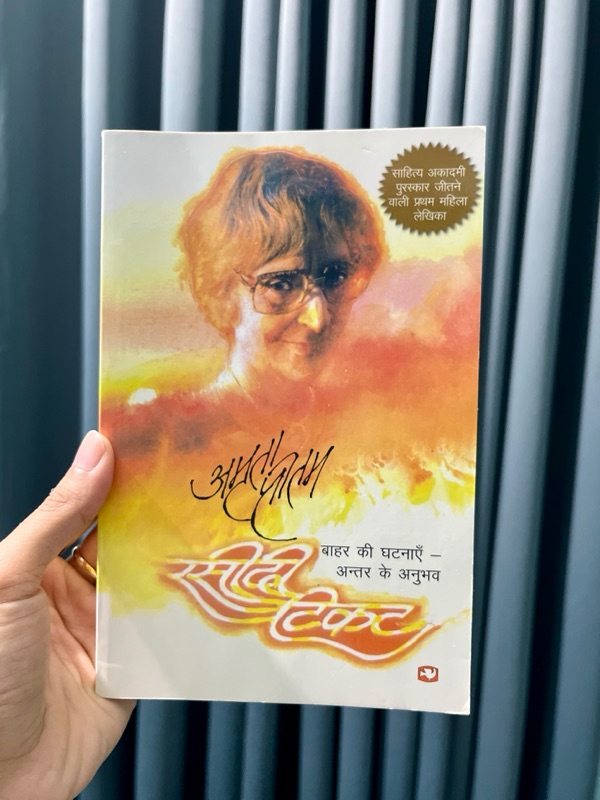
Rasidi Ticket - By Amrita Pritam

Amrita Pritam or as I like to call her, Amrita Imroz, because that part of her life is my favourite — has always been special to me. She is not just my favourite Indian author and poet, but also a personality I deeply admire and an inspiration I carry in my heart. Through her books, poems, and even documentaries, I have come to understand her love, her struggles, her depth, and her strength. She is one of the most fascinating human beings I have ever read about, someone who leaves an impact long after you hear her name. That is why this book became important to me — it is the first book of hers I have read.

Rasidi Ticket is not just an autobiography; it feels like Amrita Pritam’s heart written on paper. As you read, it feels as if she is sitting next to you, speaking directly — sometimes with pain, sometimes with love. She does not tell her life as a simple list of events, but as the story of a woman who chose courage over silence, and love even when society stood against her.

Amrita writes openly about her broken marriage, her unforgettable love for Sahir Ludhianvi, and the gentle companionship of Imroz, who gave her peace in her later years. She does not hide her scars; instead, she shows them with honesty, and in doing so, turns them into poetry.

Even the title has its own story. Sahir once told her that her whole life could be written on the back of a revenue stamp. Amrita took that casual remark and turned it into this beautiful book, proving that even a small space can hold the weight of love, loss, and courage.

Reading Rasidi Ticket feels like walking with Amrita through her memories - some quiet, some painful, and some glowing with love. The language is simple, almost like a conversation, yet every line carries emotions that stay with you long after you finish the book.

This book is not only Amrita Pritam’s story; it is the story of every woman who has dared to listen to her heart, to love beyond boundaries, and to rise again after pain. Rasidi Ticket teaches us that life, no matter how difficult, can become beautiful if lived with honesty and truth.

Rasidi Ticket is her life story, told in the free and intimate style of a diary, where thoughts, emotions, and memories flow naturally, without a defined structure.

Amrita beautifully says- “My writings—poems or prose—I know are like an illegitimate child. The reality of my world fell in love with the dream of my heart, and this forbidden union gave birth to my writings. I know my writings will carry the fate of an illegitimate child, bearing the frowns of the literary world all its life…”

AS: Happy Reading! 😀

Comments

Popular posts from this blog

Madhushala - By Harivansh Rai Bachchan

“Mitti ka tan, masti ka man, kshan-bhar jeevan — mera parichay.” I think most of us have heard of Madhushala since childhood — though many may not have actually read it. I remember watching Amitabh Bachchan recite its verses on award shows, reality shows, and even on KBC. A few years ago, I finally decided to pick up a copy for myself, and to my surprise, I realised it might be the longest poem I’ve ever read — or will ever read. A true gem of Indian literature, Madhushala has 135 verses, each one as thoughtful as the next. Recently, while looking for another book on my shelf, I came across it again, read through a few pages, and felt like sharing it here. Madhushala is one of the most celebrated works in Hindi poetry, written by the legendary Harivansh Rai Bachchan. While it speaks of wine, taverns, and cups, it is not about drinking in the literal sense. These are thoughtful metaphors used to reflect on life, emotions, struggles, and dreams. For Indian readers, Madhushala holds a spe...

The Rudest Book Ever - By Shwetabh Gangwar

He argues: Many people have kids not because they are ready, but because society tells them “that’s what you do,” or because they believe a baby will suddenly make life happy and perfect. He’s clear—bringing a child into the world just to fix your own problems or to fit in is unfair to the child. His main message is simple: a child isn’t your happiness button, it’s a huge responsibility that deserves serious thought. Shwetabh uses this example to show how people often make life’s biggest choices without really thinking. I am not a fan of any self-help books, but this one surprised me with its style, and I came to know later that the genre is self help book; otherwise I might not have picked up! The book feels like a wake-up call. Author’s blunt, direct way of writing grabs your attention. He talks on topics like rejection, self-worth, avoiding society’s traps, and the difference between chasing short-term happiness and building real, lasting contentment. Reading it feels like sitting w...

Awakening the Divine Feminine (The Pancha Prakriti Goddesses) – By Adi Krsna Rama

Lately, I have been listening to a lot of spiritual podcasts on YouTube, and spirituality as a topic has always fascinated me, since childhood. Everyone defines it differently and seeks something unique through it. Maybe this ongoing curiosity led me to this book. Interestingly, this is the only book I have ever bought without any recommendation; no reviews, no prior knowledge, nothing. I just came across it while browsing books on Amazon and instantly felt attracted to it. Sometimes, energies guide you toward certain things, they speak to you, help you make choices—and this book was one of those moments. I am really glad I trusted that instinct. The book explores the divine feminine through goddesses and their energies—how each goddess resides within us, how we can awaken their energies, and how our personalities often resonate their traits. It beautifully reminds us that spirituality is everywhere—in everything we do and everything around us. All it takes is awareness and a willingne...