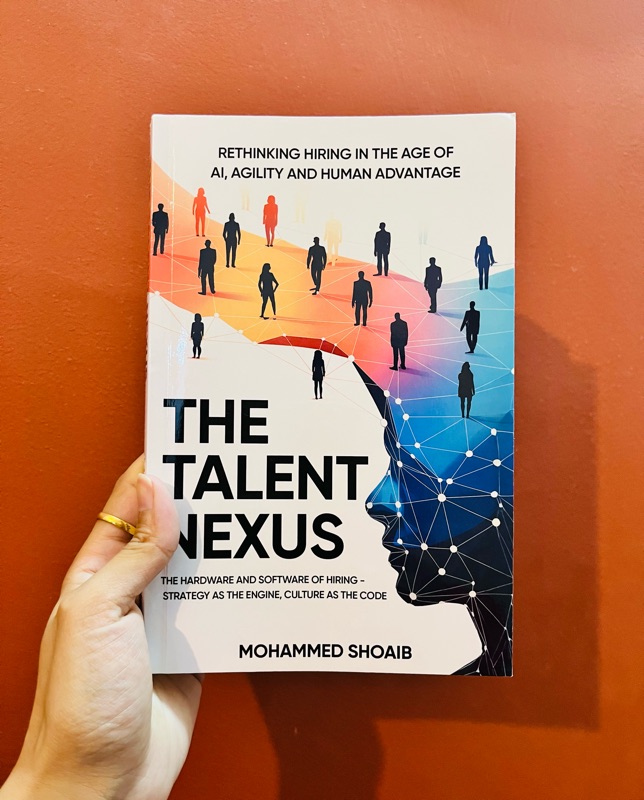
The Talent Nexus - By Mohammed Shoaib


It’s interesting how brutally honest the author is while saying: “This book is born out of frustration and conviction.”

I usually don’t pick up books that focus directly on careers or professional life. But after Shoaib’s recommendation, I decided to give this one a shot and I’m glad I did.

One line that really stood out to me was:

“Many companies are still playing the old game- hiring for pedigree instead of potential, experience instead of trajectory, compliance instead of creativity”

And that’s exactly where many organizations go wrong. The focus is often misplaced, which eventually leads to talent shortages.

The Talent Nexus by Mohammed Shoaib is much more than a book about hiring. It explores how organizations can build stronger teams and make better people decisions in a rapidly changing world.

What I enjoyed most was how it connects hiring, leadership, culture, and business outcomes. It challenges the idea that recruitment is simply about filling positions and instead presents it as a strategic advantage. The discussions around AI, employer branding, talent strategy, and human judgment feel especially relevant today.

Whether you are in Talent Acquisition, HR, or leadership, the book offers practical insights that make you pause and rethink how talent is identified, assessed, and nurtured.

One quote that resonated deeply with me was:“Hiring is a craft. It requires precision, persuasion, psychology and purpose.”

I also loved the concept of the Talent Magnet Scorecard. It highlights that impact is not just about completing a process; it’s also about how candidates feel throughout the journey.

“The stronger your signals, the stronger your magnet”

Another important takeaway was the emphasis on employer branding. It’s not just important for large organizations; startups need it too.

“Jo dikhta hai , wahi bikta hai”

A simple yet powerful reminder of why visibility and branding matter.

The book revolves around talent and everything connected to it; from attracting and evaluating people to building cultures where they can thrive.

And it closes with a topic none of us can avoid anymore: AI and automation.

I particularly liked this thought:

“Technology in talent isn’t about replacing human touch; it’s about amplifying human ingenuity, freeing us to focus on what truly matters: connection and insight.”

AS: Happy Reading! 😀

Comments

Popular posts from this blog

Madhushala - By Harivansh Rai Bachchan

“Mitti ka tan, masti ka man, kshan-bhar jeevan — mera parichay.” I think most of us have heard of Madhushala since childhood — though many may not have actually read it. I remember watching Amitabh Bachchan recite its verses on award shows, reality shows, and even on KBC. A few years ago, I finally decided to pick up a copy for myself, and to my surprise, I realised it might be the longest poem I’ve ever read — or will ever read. A true gem of Indian literature, Madhushala has 135 verses, each one as thoughtful as the next. Recently, while looking for another book on my shelf, I came across it again, read through a few pages, and felt like sharing it here. Madhushala is one of the most celebrated works in Hindi poetry, written by the legendary Harivansh Rai Bachchan. While it speaks of wine, taverns, and cups, it is not about drinking in the literal sense. These are thoughtful metaphors used to reflect on life, emotions, struggles, and dreams. For Indian readers, Madhushala holds a spe...

The Rudest Book Ever - By Shwetabh Gangwar

He argues: Many people have kids not because they are ready, but because society tells them “that’s what you do,” or because they believe a baby will suddenly make life happy and perfect. He’s clear—bringing a child into the world just to fix your own problems or to fit in is unfair to the child. His main message is simple: a child isn’t your happiness button, it’s a huge responsibility that deserves serious thought. Shwetabh uses this example to show how people often make life’s biggest choices without really thinking. I am not a fan of any self-help books, but this one surprised me with its style, and I came to know later that the genre is self help book; otherwise I might not have picked up! The book feels like a wake-up call. Author’s blunt, direct way of writing grabs your attention. He talks on topics like rejection, self-worth, avoiding society’s traps, and the difference between chasing short-term happiness and building real, lasting contentment. Reading it feels like sitting w...

Awakening the Divine Feminine (The Pancha Prakriti Goddesses) – By Adi Krsna Rama

Lately, I have been listening to a lot of spiritual podcasts on YouTube, and spirituality as a topic has always fascinated me, since childhood. Everyone defines it differently and seeks something unique through it. Maybe this ongoing curiosity led me to this book. Interestingly, this is the only book I have ever bought without any recommendation; no reviews, no prior knowledge, nothing. I just came across it while browsing books on Amazon and instantly felt attracted to it. Sometimes, energies guide you toward certain things, they speak to you, help you make choices—and this book was one of those moments. I am really glad I trusted that instinct. The book explores the divine feminine through goddesses and their energies—how each goddess resides within us, how we can awaken their energies, and how our personalities often resonate their traits. It beautifully reminds us that spirituality is everywhere—in everything we do and everything around us. All it takes is awareness and a willingne...