“I think what matters far more with a book is how it affects you.”
So far, I feel like I have read two very different sides of Japanese literature.
There is the dark, unpredictable world that Murakami creates; which I absolutely love. And then there is this other side, one that feels warm, gentle and almost too cute to be real.
And one thing I really admire about Japanese authors is the way they create such beautiful visuals with words. You can almost see the places they write about.
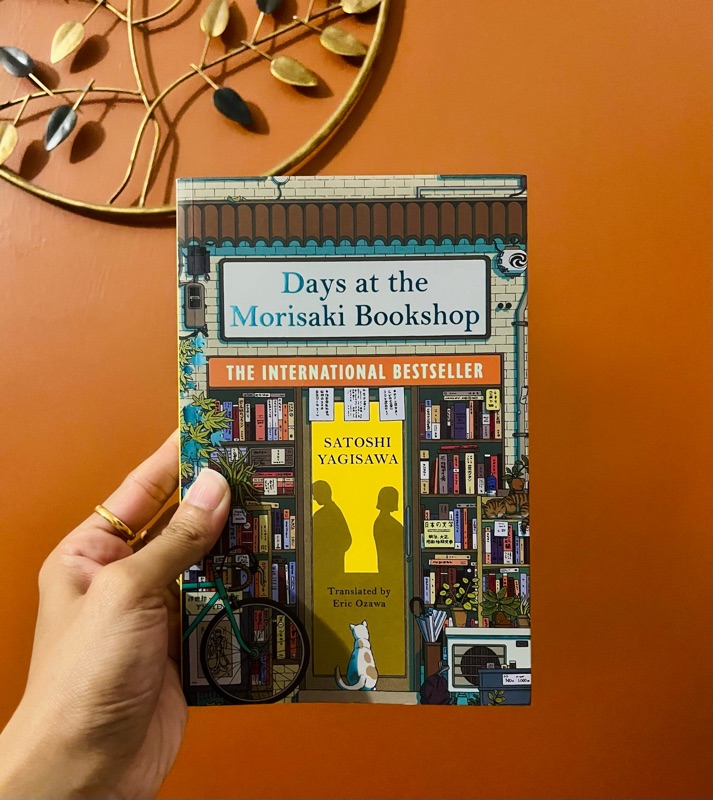
Satoshi Yagisawa has this beautiful ability to notice the smallest, most ordinary things and somehow give them emotion and meaning.
Days at the Morisaki Bookshop is a very light-hearted yet surprisingly profound book. The emotions are simple, but they are depicted so beautifully that somehow, they stay with you and leave you with this feeling of warmth.
The story revolves around Takako, who goes through a painful breakup and almost shuts herself away from the world. She enters this kind of hibernation mode; until she is called to help at her uncle Satoru’s little bookshop. And slowly, that place begins to change her.
What I really loved is how the book shows that sometimes, when we are stuck in a particular thought or feeling, we need to physically change our surroundings to change something within ourselves.
But somewhere along the way, you realise this story isn’t really just about Takako. It’s about the people around her. Their stories. Their emotions. And how we, as human beings, are constantly connected.
Because the moment we enter someone’s life, even briefly; we become a small part of their story. And they become a part of ours.
Best part of the book is the setting. The Morisaki Bookshop is located on a street filled with second-hand bookshops and book cafés and honestly, that might be my favourite visual in the entire book.
I genuinely wish I could visit a place like that someday; just walk around, browse books, sit in a little cafe and do absolutely nothing.
And now, I’m off to the second part of the book!
I absolutely loved this one. And honestly, it has made me want to explore more Japanese authors and more books like this.
“If I don’t go now to look for the place where I belong, I might end up never finding it.”
AS: Happy Reading! 😀
Comments
Post a Comment